BLP
2025/17

Economic impacts arising from the issuance of hybrid financial instruments
Introduction
This paper aims at pointing out the need for capital strengthening of Italian and European small and medium-sized enterprises (SMEs), to remedy their exponential growth of financial leverage and, particularly, of bank financing. After having outlined the features of the best-known hybrid equity financial instruments in Italy and other European countries, the purpose is also to foster the analysis on the opportunity to identify a common European financial instrument, which could be used in several Member States and meet the interests of companies, investors, both public and private, and institutions.
Hybrid financial instruments in Italy to facilitate the SMEs growth
The issuance of hybrid equity financial instruments allows the company to acquire risk capital that is not allocated to share capital, but which increases net equity with the aim of recapitalizing the company. Such kind of means is particularly advantageous for start-ups that normally have a high level of debt in the early stages of their business, as they allow them not to further “burden” their leverage and, at the same time, leave the shareholding structure unchanged.
In compliance with Italian law (particularly, art. 2346, paragraph 6, of the Italian Civil Code), following the 2003 corporate law reform, joint-stock companies (Società per azioni, hereinafter referred to as “S.p.A.”) – and now also limited liability companies (Società a responsabilità limitata, “S.r.l.”) with certain limitations that will be outlined below – are allowed to issue “hybrid” financial instruments (Strumenti Finanziari Partecipativi, “SFP”) against the contribution by shareholders or third parties in cash, in kind, or for work or services.
The qualification of these instruments as equity or debt clearly depends on their features set forth in the company’s by-laws or the regulation governing the issuance of the financial instrument. For instance, the provision of an obligation to reimburse the sum paid at a given date, along with interests to be paid at certain maturities, would lead to consider them as debt instruments.
The purpose of their introduction was to offer Italian companies, which are structurally undercapitalized and have a large debt exposure to banks, a new mean that could diversify the channels for raising financial resources. After an initial diffidence, SFPs have gained popularity, primarily due to their flexibility, as the legislator has left considerable statutory autonomy in determining the rights (both economic and administrative) that SFPs can have.
These instruments are also used in restructuring transactions, since they have the advantage of not affecting the share capital and consequently the shareholdings would remain unchanged, but they can equally increase the company’s net equity.[1]
Italian case law, which has considered SFP as equity capital,[2] has recognized their importance in restructuring transactions, stating the possibility of converting credits into equity financial instruments as a satisfactory measure for the company’s debts in the proposed arrangement.[3]
It is clear that the allocation between debt or equity essentially depends on whether the company is under an obligation to repay the sum paid: in the event that such an obligation exists, the contribution would be assimilated to a loan.
Thus, for the purpose of recapitalizing the company, it is important that the instrument has all the features to be qualified as equity (risk) capital. At that point, the contribution resulting from the subscription of the SFP should be allocated to a reserve in the net equity (patrimonio netto) of the company (the so-called “financial instrument contribution reserve”). From an accounting point of view, therefore, said reserve should be able to be used to cover losses in accordance with the mandatory order of the net equity items to be eroded in case of losses, possibly after the other available reserves if so provided for by the by-laws or the relevant regulation, but before the share capital.[4]
The economic context after the COVID-19 outbreak leads to consider equity financial instruments as a valid alternative for the recapitalization of the companies to the normal raising of capital through the use of financial leverage or by means of share capital increases intended to affect the company's shareholding structure.[5]
With regard to SMEs in Italy, which represent the most common form of business in our country, a more flexible regulatory framework has been introduced to make these companies more attractive to third-party investors.
The legal provisions initially envisaged only for innovative start-ups[6] were later extended to innovative SMEs and, most recently, to non-innovative SMEs, albeit with some relevant “shortcomings” (such as the possibility of issuing SFPs) also to non-innovative SMEs.
The aim, as also stated by the Task Force on start-ups set up by the Italian Ministry of Economic Development in 2012,[7] was to enable companies to access new resources through different channels by: (i) strengthening the venture capital market in Italy through the creation of different classes of shares; (ii) incentivizing the so-called “work for equity” with the possibility of remunerating external collaborations through the assignment of shares or SFPs; (iii) offering shares to the public through equity crowdfunding platforms to raise small amounts of capital from a large number of retail investors.
In particular, Law Decree No. 179 of 18 October 2012, converted by Law No. 221 of 17 December 2012, provides for a section dedicated to measures for the creation and development of innovative start-up companies. The so-called “Investment Compact” Decree (Decree-Law No. 3 of 24 January 2015) then extended the scope of the previous law also to innovative SMEs. Finally, Decree-Law No. 50 of 24 April 2017 introduced some relevant amendments to art. 26 of Decree-Law No. 179/2012 by replacing the words “innovative start-ups” with the expression “SMEs” in the second, fifth, and sixth paragraphs. The effect was to extend the law previously provided only for innovative start-ups to all SMEs. However, the amendment did not affect the seventh paragraph of the art. 26 (i.e. the possibility to issue SFPs), which would therefore be inapplicable to non-innovative SMEs.
The issuance of SFPs is useful for start-ups also because at that time it is difficult to make a reliable valuation of their shares. Therefore, SFPs allow to overcome this issue and make the investment attractive even in the absence of a complete valuation of the company and certainty about its future growth.
The 2019 Budget Law (Legge di Bilancio 2019 – Law No. 154 of 30 December 2018) appears to aim at expanding financing channels for SMEs and innovative enterprises, by exploiting, for example, crowdfunding platforms, a mechanism that is already regulated[8] and that can represent an important driver for raising capital for start-ups or SMEs. Incentivizing the use of these platforms certainly allows companies, in the initial stages of their business, to rely on the savings of small retail investors, without having the companies sell significant parts of their share capital to international private equity funds or foreign investors. As a consequence, equity crowdfunding platforms can play an important role for Italian SMEs that have to deal with the current social and economic context, which has been hit by the COVID-19 pandemic and is struggling with the current geopolitical tensions, which have already had a significant impact on our country’s economy.
In light of the above, allowing the placement of SFPs through online platforms would therefore have the merit of not limiting issuances to shares and debt securities, particularly today, where it is now allowed in Italy to constitute SMEs in the form of S.r.l. to issue classes of shares with economic and administrative rights similar to those of S.p.A.[9]
The remaining issue is that Law Decree No. 50/2017, although having extended to all SMEs in the form of S.r.l. the rules originally provided exclusively for innovative SMEs, has not extended the application of the law regarding the issuance of SFPs, which would therefore seem a right only for start-ups or innovative SMEs.[10] Therefore, the current economic context would require reconsidering this choice, because of the advantages that SFPs can have for companies, representing a valid alternative (and in some ways a more favorable choice for companies, as they do not require companies to open up their capital to new shareholders) to deal with the huge capitalization needs.[11]
Similar financial instruments in other EU countries
Taking a look at other European jurisdictions, many EU Member States already have legislation on hybrid financial instruments. Examples include the titres participatifs introduced in France by the Law of 1 January 1983 and governed by art. 228-236 and 228-237 of the Code de commerce. These instruments are represented by paper securities that can only be issued by certain types of companies, including companies operating in the public sector or cooperatives in the form of joint stock companies or limited liability companies. Also, they allow the holder to receive a part of the company's profits, although he or she does not become a shareholder of the company.
Closer to being considered equity capital are instead the valeurs mobilières composées or titres composés, which represent a broad category of securities that provide access to a company’s risk capital.
Financial instruments in France can be divided into: (i) bonds (governed by arts. 228-38/90 of the Code de commerce) (ii) titres participatifs, as mentioned above, and (iii) valeurs mobilières composées, which in turn can be subdivided into equity capital and debt instruments.
Among the valeurs mobilières composées belonging to the category of equity, there are, for example, the so-called prêts participatifs, which have more equity nature than the titres participatifs since they cannot be reimbursed unless all other creditors of the company have been paid in full. However, unlike the titres participatifs, they do not enjoy the common rights of a shareholder, either of an administrative or economic nature.[12]
Continuing with the examination of the main examples of “hybrid” securities used in European countries, it is worth recalling the so-called “parts bénéficiaires” provided for by Belgian law, which are considered the most similar instrument to our SFPs.[13] Belgian law, similar to Italian law, does not provide a specific definition of the features of these instruments, but only specifies that such instruments are not part of the share capital. The by-laws will set forth their administrative and economic rights.
The parts bénéficiaires are qualified as so-called “horse capital” securities, a category in which all securities that are not part of the share capital.
The issuance of the parts bénéficiaires may take place either at the time of incorporation of the company or afterwards, against contributions in cash, in kind, or for work or services, as they may be allocated to shareholders, other stakeholders, and employees. Although there are some differences with respect to the law of SFPs in Italy regarding, in particular, the administrative rights pertaining to the holders thereof, it is worth noting that the parts bénéficiaires may represent both equity and debt securities, depending on the rights set forth in the by-laws.
Similarly to Belgium, the German legislator has introduced the so-called Genuβrechte under § 221 of the German AktG. As it has been pointed out, Genuβrechte consist in a sort of obligation providing several economic rights without receiving any shareholding of the company. However, the right to repay the sum is limited to situations where the financial instrument has all the features of a loan.[14]
The German legislator, too, has left a great statutory autonomy in defining the terms and characteristics of these instruments. Nonetheless, the general rule remains that under no circumstances may these instruments represent portions of the share capital and, consequently, the holders of these instruments may be granted the right to vote nor the right to appeal resolutions of the shareholders’ meetings.
The financial debt trend of Italian and European SMEs
The equity financial instruments described in the previous paragraphs can be a viable alternative to raise financial resources for Italian and European SMEs, facilitating their recapitalization without further burdening the debt on their balance sheets.
With reference to Italy, it is worth focusing on the data relating to the financial indebtedness of our SMEs, and, in particular, on the debt-equity ratio.
The chart below (Fig. 1) shows the trend of the financial debt of Italian SMEs (broken down by geographical area) over the 2007-2022 period. The chart shows an increase in indebtedness in 2022 compared to 2021, continuing the trend from the pandemic crisis.[15]
Figure 1
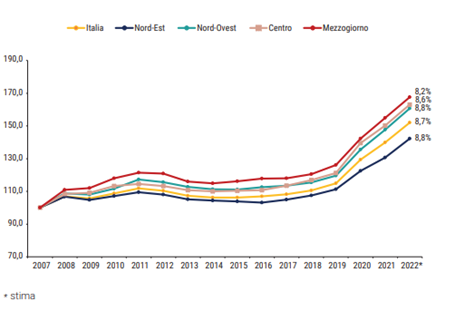
Source: Confindustria, Cerved, Rapporto Regionale PMI 2023
In line with the foregoing, the economic outbreak resulting from the COVID-19 pandemic has exponentially increased access to bank credit by Italian enterprises. As per the graph below (Fig. 2),[16] in 2020 access to bank financing has registered a growth rate of 8.6% compared to the substantial stability of the three-year period from 2017 to 2019, and reduction rates of 1.7% and 3.8%, respectively, in 2009 and in the average of the two-year period from 2012 to 2013.
Figure 2

Source: Bank of Italy, Audizione sulle tematiche relative allo squilibrio della struttura finanziaria delle imprese italiane che rischia di essere determinato dalla pandemia da Covid-19
In addition, it should be noted that the cost of SMEs’ debt has been on the rise since 2013, with a financial expense-financial debt ratio rising from 2.8% in 2021 to 3.4% in 2022. Clearly, this increase is strongly affected by the European Central Bank’s (ECB) constant increase in rates.
The chart below (Fig. 3) shows the cost of debt for SMEs, as a percentage of the financial expense-financial debt ratio, over the period from 2007 to 2022.
Figure 3

Source: Confindustria, Cerved, Rapporto Regionale PMI 2023 Confindustria-Cerved
Furthermore, it is worth focusing on the data relating to the trend of financial debts in relation to the equity of Italian SMEs (Fig. 4). The increase in financial leverage is observed in all Italian areas, with a financial debt-equity ratio estimated at a total of 64.6% in 2022 (a 2% increase compared to the previous year).
Figure 4

Source: Confindustria, Cerved, Rapporto Regionale PMI 2023 Confindustria-Cerved
As also suggested by the Report of Confindustria-Cerved, the resilience of the production system has benefited from the measures introduced by the State, which have allowed to preserve the economic-financial solidity of companies during the pandemic period. In the long-term period, however, there is a need to support the dimensional growth of enterprises by favoring a diversification among financial sources and the strengthening capital.
A solution to prevent bankruptcies related to situations of excessive indebtedness must be sought in policies aimed at encouraging processes of equity strengthening and risk capital raising.[17]
In the Eurozone, too, SMEs dependency on banks remains high, with 70% of external financing being reliant on banks, against 40% in the US, where market funding plays a bigger part.[18]
According to the “Survey on the access to finance of enterprises”,[19] conducted by the European Commission, debt financing (with particular reference to credit lines and bank loans) remains the most important source of financing for European SMEs as well.
Furthermore, as shown in the graph below (Fig. 5), extrapolated from the Survey, the continuous demand for bank financing from SMEs in the various Member States remains high.
Figure 5

Source: European Commission, Survey on the access to finance of enterprises
Notwithstanding the foregoing, according to the interviews released by a set of European SMEs, the Survey shows that higher interest rates and collateral requirements will make access to bank loans more difficult than in the past, leading to significant obstacles to SMEs’ growth,[20] as they are more concerned about still being able to access certain forms of financing.
A solution to these challenges could lie in a greater openness towards raising equity resources, provided that the equity raising is structured in such a way as to reduce the entry of third-party investors into the shareholder structure. This fact that SMEs still perceive bank financing as an important resource, as from also a cultural point of view, opening up their share capital to third parties (especially in the European business context, where companies are mostly under the control of founding families) is something that companies generally avoid pursuing.
Venture capital as a measure to support companies’ recapitalization
In a nutshell, venture capital (VC) is a form of private equity investment aimed at selecting entrepreneurial projects (generally in the technology sector) with strong growth potential with the purpose of providing the necessary financial support for their growth. The venture capital industry was born in the United States thanks to private initiatives but also to strong public measures.[21]
Policymakers in different countries have repeatedly attempted to favor VC through public initiatives and, mainly, private incentives,[22] which, however, have often not brought the desired results due to several variables, both economic and cultural.
It is worth pointing out that the absence of an attractive capital market as well as a dynamic M&A (Mergers & Acquisitions) environment, which are the major incentives for venture capitalists to obtain an exit from their investment, are perhaps to be considered the main issues of the failure to develop a European VC market similar to the American one.
The legal tool that is often used in the raising of equity in VC, introduced by the US experience, is the so-called “S.A.F.E.” (Simple Agreement for Future Equity), a contractual model designed specifically for start-ups by the American accelerator YCombinator.[23]
New hybrid instruments used in this context also include “Convertible Security” or “Convertible Equity”[24] and KISS (Keep It Simple Security).[25]
The success of the SAFE in the American environment is due to its ease of understanding as well as its brevity and standardization. Furthermore, the contractual model is easily accessible online[26] and is super partes, as it was developed and disseminated by the most successful incubator in this field.
In brief, the SAFE[27] is a contract between the investor and the company whose standard content provides for an automatic conversion of the amount paid by the investor in the seed stage into a future shareholding in the start-up’s share capital at the time of the first round of capital increase normally carried out by a venture capital fund. While the venture capital fund will negotiate a series of complex clauses for its entry into the shareholding structure, the SAFE holder’s negotiation is usually limited to: (i) the amount of the investment and (ii) the discount on the subscription price of the shares to be applied when the capital increase round takes place (bonus mechanisms may provide for discounts on the subscription price of the new shares or a so-called “valuation cap”, according to which the value of the company to be taken into account for the conversion of the SAFE into shares cannot exceed a certain threshold). In any case, for the same amount invested, the holder of the SAFE will benefit from a greater shareholding (even preferred shares may be obtained) than that allocated to the next investor.
SAFE in the US, moreover, does not have an expiration date (so the conversion can remain suspended sine die), there are no repayment obligations for the company, and no interest accrues on the sum paid. In fact, the goal of those who decide to invest in the seed stage of a start-up is not to accrue interests or to have the investment repaid after a certain period of time, but to be able to benefit from a subsequent round of capital increase by a venture capitalist, being able to obtain better terms for the conversion into shares of the company (some forms of SAFE regulation require the entrepreneur to sound out the willingness of investors to invest in the company).
Although in Italy, starting in 2012, a policy of reforms was launched to replicate the Silicon Valley model,[28] with the aim of stopping the rush to bank financing (in the long period no longer sustainable), there are still significant limits to the transposition of similar investment models in our country, for legal as well as cultural and economic reasons.[29]
From a legal point of view, on one hand, our system provides for a series of regulatory provisions and principles developed by scholars and the case law (which are also the result of our legal culture) that can effectively prevent the use of means similar to the American SAFE (at least without some important “correctives”).[30] From a cultural and economic point of view, on the other hand, as mentioned above, in order for such instruments to really work and be attractive for the investors, it would be necessary to have an economic system ensuring forms of exit, facilitating, and incentivizing access of the companies to the capital market, through stock market listings or investments by private equity funds.
In Italy, the raising of capital by start-ups is still complicated, as access to the markets of the Italian stock exchange (including multilateral trading facilities such as Euronext Growth Milan created to incentivize the listing of SMEs on the stock exchange) remains complex. This does not facilitate the diffusion of means with similar features to the American SAFE, since the investor would have serious difficulty in obtaining the same benefits he or she would have elsewhere.
Therefore, in addition to the reforms underway in our country to encourage investment in companies (especially in their start-up phase), it would be also important to show greater openness towards innovative forms of investment that meet the needs of companies and investors, without necessarily erecting barriers based on legal and cultural concepts that, in some cases, could be considered outdated.[31]
Introduction of a common financial instrument at the European level
The European Union, through the Opinion of the European Economic and Social Committee (EESC), on “Recapitalising EU companies — An innovative way towards sustained and inclusive recovery”[32] drew attention to the significant shortage of equity and hybrid capital among EU companies and to the fact that economic impacts arising from geopolitical tensions could jeopardize the stability of many companies overly reliant on bank financing.
In this context, the EESC has recommended the establishment of a common framework at the European level that would encourage the issuance of hybrid financial instruments, allowing companies to strengthen their balance sheets while maintaining their level of investment without increasing leverage. This would enable companies to remain competitive and adapt to future changes by having the resources to promote a green and digital transformation.
As pointed out by the EESC, hybrid instruments would have the advantage of being a simpler solution for companies to implement and would also be much appreciated by family-owned companies (which account for 60% of EU companies), as the founder usually intends to retain control of the entity and is not always inclined to open up the share capital to third-party investors. Clearly, for such hybrid instruments to achieve the indicated results, they would need to have the characteristics to be allocated in net equity and not in debt of the company.
Therefore, the EESC has recommended a dialogue between the main players in the European market, including private and public institutions, banks, fund managers, institutional investors, insurance companies, and pension funds, with the aim of achieving a common financial instrument model to be disseminated in the European economic context, which could be attractive to investors seeking hybrid instruments capable of guaranteeing high returns, and at the same time meet the recapitalization needs of companies, without undermining the balance between shareholders.
The need for risk capital as a result of the COVID-19 pandemic and the reduction of business support measures by the Member States has been estimated at EUR 450-600 billion, as per EESC Opinion.
The aim would be to identify a hybrid equity (or quasi-equity) instrument that could be used in the different regulatory systems of the various Member States, with similar features and incentive mechanisms, as well as standardized tax and accounting treatment, so as to be attractive to companies and investors. In addition, such instruments could also be designed with additional eligibility criteria or conditions, e.g. an ESG assessment for their issuance in the European economic system in order to target investments, especially in those companies that support the EU’s transition to a more sustainable economy.
In early 2021, an interesting report was published by the Association for Financial Markets in Europe (AFME) in collaboration with PricewaterhouseCoopers (PWC).[33] It started from an analysis of the size of total equity financing needs, comparing them with estimates of equity resources available in the public and private sector. In summary, there is an estimated EUR 1 trillion equity funding need, and the availability of equity and hybrid capital in the public and private sectors across the EU is between EUR 400 and 550 billion. Therefore, European enterprises will need to access an additional EUR 450 billion to EUR 600 billion in non-debt funding to avoid a very damaging medium-term rise in the leverage and operating flexibility of the overall European market.
Based on feedback received from companies and investors, in order to understand which instruments investors are willing to invest in with the aim of bridging the equity gap, the report has also proposed the creation of a common quasi-equity instrument with certain characteristics that would meet the needs of companies and investors.
Interviews with institutional investors and companies that participated in the survey confirm, in fact, that an instrument of this type could have broad appeal among institutional investors, such as pension funds and insurance companies, who are looking for risk profiles similar to debt but with better returns, provided that, however, they are able to correctly assess the type of risk they are taking on.
One of the needs always expressed by entrepreneurs, particularly in family businesses, is to be able to maintain control of their companies. Therefore, a financial instrument that does not dilute shareholders’ stakes could certainly attract more interest. Investors, on the other hand, might be attracted by an investment that guarantees constant cash flow, in any case related to the company's performance, in a sort of dividend preferred over the shareholders. Moreover, certain exit mechanisms after a certain period of time or upon the occurrence of certain trigger events established ex ante as well as the possibility of converting the instrument into ordinary share capital after a certain period of time are features that may make investment more attractive for both parties.
In addition, as already pointed out in the context of SFPs issued under Italian law, it is crucial that the contribution resulting from the subscription of these hybrid instruments be allocated to the company's net equity, so as not to further affect existing indebtedness. In the event of insolvency, these instruments should have a subordinate status, ranking after common creditors and before shareholders.
This project could help to achieve the European purposes in the creation of the so-called “Capital Market Union” through a common financial instrument, with recognizable features in all Member States and attractiveness to investors, which could facilitate the flow of capital at the European level. At the same time, it would guarantee that companies, especially SMEs, can access new sources of financing, which would also respond to the expressed need of families not to alter the ownership structure of their companies.
Conclusion
In the light of the framework outlined above and the goals that the European institutions aim to pursue, one of the points we are focusing on is the strengthening of the equity of SMEs, especially after the pandemic crisis and in the current geopolitical context that continues to bring significant economic impacts. It is therefore relevant to incentivize equity investment in companies, trying to replicate the US experience, also leading to the creation of hybrid financial instruments that support companies and are, at the same time, attractive to investors, including private ones.
European and national institutions have already moved in this direction, although desired results have not yet been fully achieved. The hope, therefore, is that future economic policies will specifically really address and incentive this phenomenon, leading private investors to rely on these types of instruments. In the long term, these policies could enable our companies to depend less on bank financing, and consequently have greater exponential growth.
See F. Innocenti, ‘Gli Strumenti Finanziari Partecipativi alla Prova Della Giurisprudenza’, in Le Società, n. 3, 2022, p. 373 ss.
See Court of Naples, sec. Imprese, 24 February 2016, Ord., in Notariato, 2016, p. 268 ss., with a comment by G. D’Attorre, ‘Perdite Della Società e Tutela dei Titolari di Strumenti Finanziari Partecipativi’, in Notariato, 2016, p. 273 ss.; M. Lamandini, ‘Strumenti Finanziari Partecipativi e Ordine di Priorità Nella Partecipazione alle Perdite’, in Le Società, 2016, p. 976 ss.; Court of Bologna, sec. IV, 1 October 2020, available at www.ilfallimentarista.it, 10 March 2021.
See Court of Ravenna, sec. Fall., 29 May 2020, in De Jure and in Fall., n. 1, 2021, p. 83 ss., with a comment by P. Rinaldi, ‘Strumenti Finanziari Partecipativi Come Modalità Satisfattiva Principale nel Concordato Preventivo’; Court of Rome, sec. Fall., 17 July 2020, n. 2900, in De Jure.
Court of Naples, sec. Imprese, 24 February 2016, Ord., stated that the conversion into share capital of the SFPs would therefore be possible within the limits of the relevant equity reserve. See also Notarial Council of Milan, Diritti Patrimoniali degli Strumenti Finanziari Partecipativi, n. 164/2017, according to which the economic rights of the holder of the SFPs do not cease if the relevant reserve is no longer existing, except for the conversion right, which, on the other hand, is extinguished if the company’s shares have a nominal value.
See L. Stanghellini, R. Rinaldi, ‘Trasformazione dei Prestiti Covid-19 in Strumenti Finanziari Partecipativi (SFP). Un’idea per Far Ripartire il Sistema delle Imprese’, in IL CASO, 3 April 2020, p. 1 ss.
See D.L. n. 179 of 18 October 2012 for the criteria to be considered “innovative”.
Task Force on startups established by the Ministry of Economic Development, ‘Restart, Italia!’, 2012, available at https://www.mimit.gov.it/images/stories/documenti/layout_startup_summary-versione-inglese.pdf.
See Consob, Regulation n. 22720, 2023.
Before the 2019 Budget Law, some scholars had already stated the possibility that SFPs may be issued through online portals. In this respect, see N. Abriani, ‘Quote, categorie di quote e strumenti finanziari delle S.r.l. PMI: possibilità di razionalizzazione del sistema?’, in Società a Responsabilità Limitata, Piccola e Media Impresa, Mercati Finanziari: Un Mondo Nuovo?, 2020, p. 87.
E. Fregonara, A. Cetra, ‘Le s.r.l.-P.M.I.: disciplina legale e autonomia statutaria’, in Banca, Borsa, Tit. Cred., n. 73(6), 2020, p. 815 ss., according to whom it does not seem reasonable that such a right should be reserved exclusively for innovative companies.
E. Fregonara, ‘Strumenti finanziari partecipativi, imprese innovative e PMI s.r.l.: questioni aperte’, in Orizzonti del Diritto Commerciale, n. 1, 2019, p. 253.
See Crèmieur, Esrael, ‘L’assimilation des prêts participatifs à des fonds propres’, in Riv. Soc., 1983, p. 751.
For a comparative analysis between the parts bénéficiaires and the Italian SFPs, see C. Cincotti, ‘L’esperienza delle parts bénéficiaires belghe e gli strumenti finanziari partecipativi previsti dall’art. 2346 c.c.’, in Banca, Borsa, Tit. Cred., n. 2, 2004, p. 221 ss.
M. Miola, ‘Gli strumenti finanziari nella società per azioni e la raccolta del risparmio tra il pubblico’, in Riv. Dir. Comm., n. 1, 2005, p. 440.
See Confindustria, Cerved, Rapporto Regionale PMI 2023, 26 June 2023.
A. De Vincenzo, ‘Audizione sulle tematiche relative allo squilibrio della struttura finanziaria delle imprese italiane che rischia di essere determinato dalla pandemia da Covid-19’, videoconference hearing in front of the VI Committee (Finance) of the Chamber of Deputies, 18 March 2021.
A. De Vincenzo, ibid.
See J.B. Mounier, ‘European SMEs Financing Gap’, Euler Hermes, available at https://www.allianz-trade.com/content/dam/onemarketing/aztrade/allianz-trade_com/en_gl/media/english/press-release-pdf/Euler_Hermes_European_SMEs_Financing_Gap.pdf.
See Verian, GDCC, ‘Survey on the access to finance of enterprise (SAFE).
Analytical Report 2023’, European Commission, December 2023, available at https://single-market-economy.ec.europa.eu/document/download/498e0a83-f1db-4a1f-8cc7-b20fa9a7effd_en?filename=Analytical%20Report%20SAFE%202023.pdf.
The previous EU survey already showed that SMEs claimed to face more obstacles than large enterprises to access bank loans (7% of SMEs compared to 4% of large enterprises), having lower success rates (72% compared to 85%) and a higher rejection rate (6% compared to 2%) as well as worse conditions.
S.E. Ante, Creative Capital: George Doriot and the Birth of Venture Capital, Harvard Business Press, Cambridge (MA), 2008. T. Nicholas, VC: An American History, Harvard University Press, Cambridge (MA), 2019. M. O'Mara, The Code. Silicon Valley and the Remaking of America, First Edition, Penguin Press, New York, 2019.
B. Lelux, B. Surlemont, ‘Public versus Private Venture Capital: Seeding or Crowding out? A pan-European Analysis’, in J. Bus. Ven., n. 18, 2003, p. 81 ss.
YCombinator is probably the best-known start-up accelerator in the US. This accelerator allows start-ups to obtain the so-called “seed capital” (in exchange for an equity stake in the company) but also offices and, above all, allows them to get in touch with an important community of investors (venture capitalists) as well as advisors able to help the start-ups in their growth path. Regarding the role of YCombinator in the VC industry, see J.M. Green, J.F. Coyle, ‘Crowdfunding and the Not-So-Safe SAFE’, in Virginia Law Review Online, n. 102, 2016, p. 172.
Introduced by Adeo Ressi, founder of the Founder Institute, together with Yokum Taku and announced by Techcrunch.
On the type of instruments used in the US by start-ups to raise capital, see J.M. Green, J.F. Coyle , ‘The SAFE, the KISS and the Note: A Survey of Startup Seed Financing Contracts’, in Minnesota Law Review, n. 103, 2018, p. 101 ss.
With reference to YCombinator’s SAFE, see the different types of SAFE available at https://www.ycombinator.com/documents.
For an examination of the features of the SAFE in the US, see J.M. Green, J.F. Coyle, ‘The SAFE, the KISS and the Note: A Survey of Startup Seed Financing Contracts’, in Minnesota Law Review, n. 103, 2018, p. 105.
For instance, see Task Force on startups established by the Ministry of Economic Development, ‘Restart, Italia!’, 2012, available at https://www.mimit.gov.it/images/stories/documenti/layout_startup_summary-versione-inglese.pdf.
For an analysis on the possible adoption of SAFE in the Italian legal system, see, among others, F. Redoano, ‘Il “Simple Agreement for Future Equity” nel diritto italiano’, in Banca, Borsa, Tit. Cred., n. 6, 2021, p. 971 ss.
On this point, see A. Nigro, L. Enriques, ‘Venture capital e diritto societario italiano: un rapporto difficile’, in Analisi Giuridica dell’Economia, n. 1-2, June-December 2021, p. 149 ss.
L. Enriques, ‘Do Corporate Law Judges Matter? Some Evidence from Milan’, in Eur. Bus. Org. L. R., n. 3, 2002, p. 765 ss. C. Gamba, Diritto Societario e Ruolo del Giudice, Cedam, Padova, 2008. P. Agstner, A. Capizzi, P. Giudici, ‘Business Angels, Venture Capital e la nuova s.r.l.’, in Orizz. Dir. Comm., n. 2, 2020, p. 353 ss.
European Economic and Social Committee, ‘Recapitalising EU companies - An innovative way towards sustained and inclusive recovery’ (own-initiative opinion), EESC, 26 October 2022, available at https://www.eesc.europa.eu/en/our-work/opinions-information-reports/opinions/recapitalising-eu-companies-innovative-way-towards-sustained-and-inclusive-recovery.
See Association for Financial Markets in Europe in collaboration with PWC, Recapitalising EU businesses post Covid-19. How equity and hybrid markets instruments can drive recovery, January 2021, available at https://www.afme.eu/Portals/0/AFME_COVID-19Recapitalisation2020.pdf?ver=2021-01-18-161527-010.